
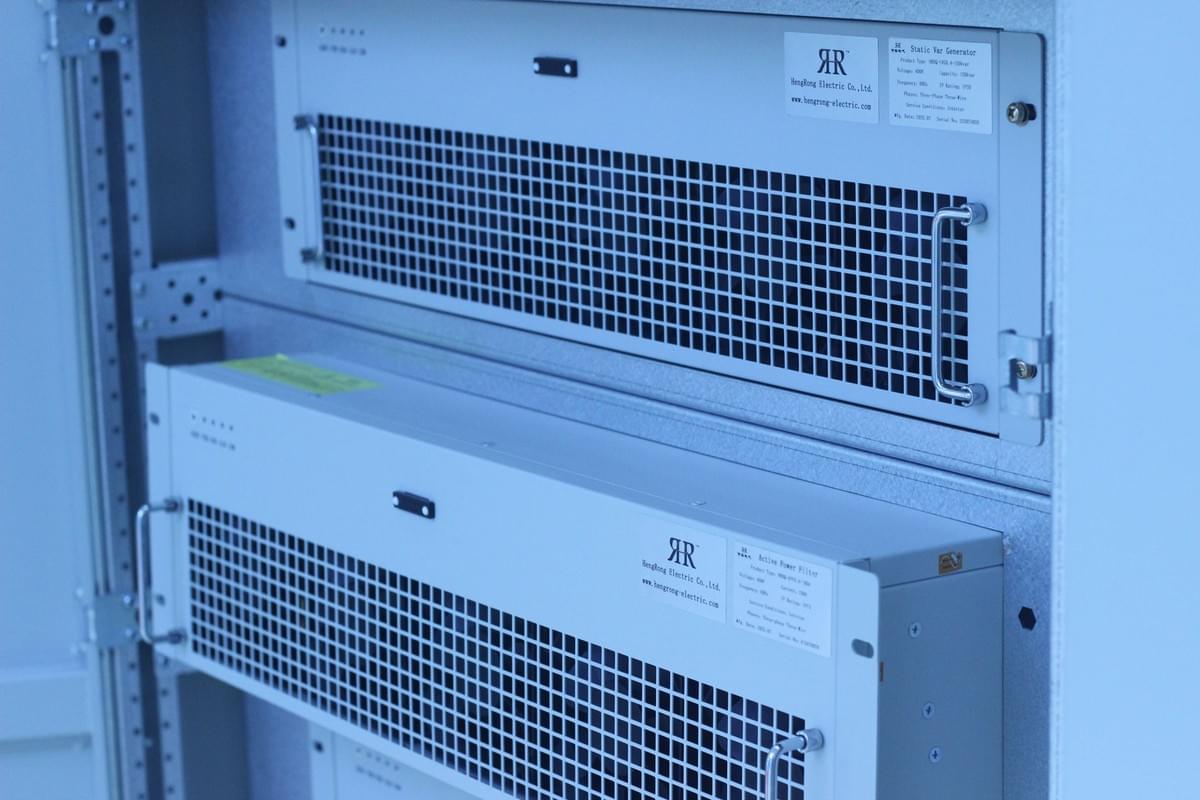
In today's era, where power electronics technology has fully penetrated industrial production and residential electricity use, the widespread application of non-linear loads has led to increasingly prominent grid harmonic pollution. This not only affects the stable operation of power equipment but also causes energy waste, running counter to the global "carbon neutrality" goal. Active Power Filter (AHF), as a core device for harmonic mitigation, has become a key force in improving power quality and optimizing power factor correction, thanks to its advantages of low requirements for energy storage components and no additional grid interference. This article will deeply analyze the innovative control technology of AHF and explore how the composite strategy of Selective Harmonic Repetitive Control (SHRC) and Proportional-Integral (PI) control enables AHF to achieve a leap in efficiency in harmonic compensation.
AHF: The Core Pillar of Grid Harmonic Mitigation and Power Factor Correction

AHF (Active Power Filter) is a compensation device based on power electronics technology, with dual functions of harmonic suppression and reactive power compensation, playing an irreplaceable role in optimizing grid power quality. In scenarios such as industrial production lines, new energy power stations, and commercial buildings, non-linear loads such as frequency converters and rectifiers generate a large number of harmonics, leading to grid current distortion, reduced power factor, increased power loss, and potential equipment failures. By real-time detecting grid harmonics and reactive current, AHF actively injects reverse compensation current, which can not only accurately offset harmonic components but also optimize the effect of power factor correction, realizing efficient use of electrical energy.
Against the background of the "carbon neutrality" strategy, the energy-saving value of AHF is more prominent. Through efficient harmonic mitigation and power factor correction, AHF can reduce useless power loss in the grid, improve power transmission efficiency, and indirectly reduce fossil energy consumption and carbon emissions. At the same time, AHF has strong adaptability to new energy power generation systems, which can effectively solve the harmonic problems caused by the grid connection of new energy sources such as photovoltaic and wind power, escort the large-scale application of clean energy, and help the energy structure transform towards low carbonization.
Limitations of Traditional Control Schemes: The Technical Bottlenecks AHF Urgently Needs to Break Through

Although the main circuit structure of AHF has become increasingly mature, the control strategy has always been the core determining its harmonic mitigation capability. The traditional control methods commonly used in AHF, such as hysteresis control and synchronous rotating coordinate control, have obvious shortcomings: hysteresis control has a fast response but unstable switching frequency and high design difficulty; synchronous rotating coordinate control is not practical enough in tracking multi-frequency harmonics, making it difficult to meet the compensation needs of complex power grids.
The early repetitive control technology can achieve zero-static-error tracking of periodic signals, but the traditional repetitive control treats all harmonics "equally" without targeting the degree of harmonic harm, resulting in poor dynamic response performance and inability to cope with scenarios where grid loads change instantaneously. The simple PI control, although simple in structure and fast in dynamic response, is difficult to achieve high-precision tracking of harmonic signals, failing to meet the requirements of AHF in steady-state compensation accuracy. These technical limitations make it difficult for traditional AHF to balance dynamic response speed and steady-state compensation accuracy, restricting its application in high-demand power scenarios.
Innovative Composite Control Strategy: The Core Code for AHF Performance Upgrade

To break through the bottlenecks of traditional control technologies and allow AHF to play a greater role in harmonic mitigation and power factor correction, the composite control strategy of Selective Harmonic Repetitive Control (SHRC) and PI has emerged as the times require. This innovative scheme combines the advantages of two control technologies, solving the problem of insufficient PI control accuracy and making up for the slow dynamic response of repetitive control, enabling a qualitative leap in the comprehensive performance of AHF.
Selective Harmonic Repetitive Control (SHRC) is a precise control technology designed for the core needs of AHF. Based on the internal model principle, it accurately locks the harmonic components with great harm and high proportion in the power grid (such as the common 6k±1 order harmonics) by constructing internal models matching specific harmonic orders, realizing targeted compensation. Different from the traditional repetitive control that "covers all" harmonics, SHRC focuses on key harmonics, reduces the internal model delay link, greatly improves the dynamic response speed of AHF, and enables AHF to quickly respond to harmonic fluctuations when the grid load changes instantaneously.
PI control provides stable dynamic support for AHF. PI control has a simple structure and convenient parameter adjustment, which can effectively enhance the dynamic response capability and stability of the AHF system. When the grid load or harmonic components change suddenly, PI control can quickly adjust the compensation strategy, avoid system oscillation, and ensure the real-time response performance of AHF. Combining SHRC with PI control to form the composite control current loop of AHF, SHRC is responsible for improving the steady-state compensation accuracy and reducing the total harmonic distortion rate, while PI control is responsible for optimizing the dynamic response speed. The two work synergistically, enabling AHF to not only achieve precise harmonic compensation and efficient power factor correction but also adapt to the dynamic changes of complex power grids.
In addition, the introduction of improved SHRC further optimizes the control performance of AHF. By adding auxiliary compensators, lead links, and low-pass filters, the improved SHRC effectively improves the stability and anti-interference ability of the system, allowing AHF to maintain excellent harmonic compensation effects even in non-ideal grid environments, and further expanding the application scenarios of AHF.
Prominent Application Value: AHF Helps the Power Grid Step into a New Era of High Efficiency and Low Carbon

The application of the SHRC+PI composite control strategy enables AHF to play a greater role in harmonic mitigation, power factor correction, and the realization of the carbon neutrality goal. In industrial scenarios, AHF equipped with this composite control strategy can accurately manage the harmonics generated by non-linear loads in the production line, optimize the power factor, reduce power loss, lower equipment maintenance costs, and improve production efficiency; in new energy power stations, AHF can effectively solve the harmonic problems of new energy grid connection, ensure the stable operation of the power grid, and promote the consumption of clean energy; in commercial buildings and residential communities, AHF can improve the power quality of the grid, avoid the damage of harmonics to household electrical equipment, and reduce power consumption, contributing to low-carbon life.
From the perspective of industry development, this innovative control technology not only improves the core competitiveness of AHF but also promotes the technological upgrading of the power electronics industry. With the in-depth advancement of the "carbon neutrality" strategy, the power grid's requirements for power quality and energy efficiency will continue to increase. As a key energy-saving and consumption-reducing equipment, the market demand for AHF will continue to expand. The mature application of the SHRC+PI composite control strategy will make AHF more advantageous in harmonic mitigation and power factor correction, providing a solid guarantee for the efficient, low-carbon, and stable operation of the power grid.
In the future, the technological development of AHF will focus more on intelligence, high frequency, and integration. By integrating digital control, artificial intelligence, and other technologies, AHF will realize adaptive detection and precise compensation of harmonics, further improving control accuracy and response speed; at the same time, with the upgrading of power electronic devices, the volume of AHF will continue to shrink, and efficiency will continue to improve, better adapting to various application scenarios. As the core equipment for grid harmonic mitigation and power factor correction, AHF will play an increasingly important role in the energy transition and carbon neutrality process, contributing key forces to building a clean, low-carbon, safe, and efficient energy system.



At HengRong Electrical, we understand that every detail in power control matters. From advanced product design to innovative filtering solutions, we are committed to delivering reliable, efficient, and future-ready technologies. By choosing Hengrong, you gain more than just products — you gain a trusted partner dedicated to helping your business achieve smarter, safer, and greener operations.
www.hengrong-electric.com